How I Ended Up Selling Software to Aesthetic Clinics
Last year, for our senior capstone project, we made a healthcare communication platform for medical professionals. Just like you or me, doctors often consult with peers, and while they do hold an incredible amount of knowledge, there are plenty of cases where obtaining a second opinion is useful.
Say you're a dermatologist and someone comes in with a unique condition. Most of the time you know exactly what it is, write a script, and the patient recovers. But sometimes, there are cases where you have a good sense of what it is but still want to run it by other dermatologists to be certain. Speaking as a patient, I appreciate the extra effort.
Doctors already do this all the time through what are called “curbside consults.” Usually, they'll grab a peer in the same clinic or someone else they know and quickly run the case by them. This works very well and has a low cycle time when the right person is nearby.
When the immediate network isn't nearby, doctors rely on informal channels such as Facebook groups, group chats, and other low-friction ways of communicating with peers outside their immediate network. They aren't throwing patient info out onto the internet, but these platforms weren't designed around medical privacy or identity verification. There was no general, trusted way to know that everyone on the other side of the conversation was who they said they were.
Ultimately, this was what we worked on solving throughout the capstone. I don't think we realized how big of a gripe this was until we started, but every single user we interviewed loved it, and toward the end we got some tentative interest from investors and started to think about whether this could work as a business. We had an MVP, so the logical next step was finding out whether there were buyers, e.g., hospitals.
Early in the diligence process, it became clear that hospitals had very little incentive to pay for something they didn't see a direct financial return from. In other words, healthcare is organized into deliberate provider and insurance networks, while our product was essentially designed to ignore those boundaries and let doctors consult freely across them. Doctors loved it, but it was much harder to explain why the institutions maintaining those networks should pay to make those boundaries less relevant.
This stung quite a bit as we received a tremendous amount of positive feedback from doctors. In retrospect, while we did talk to a ton of users, we didn't talk to the buyers.
As an aside, if you're interested in how this space has evolved, check out OpenEvidence, a startup building an AI medical-knowledge product aimed at a related need.
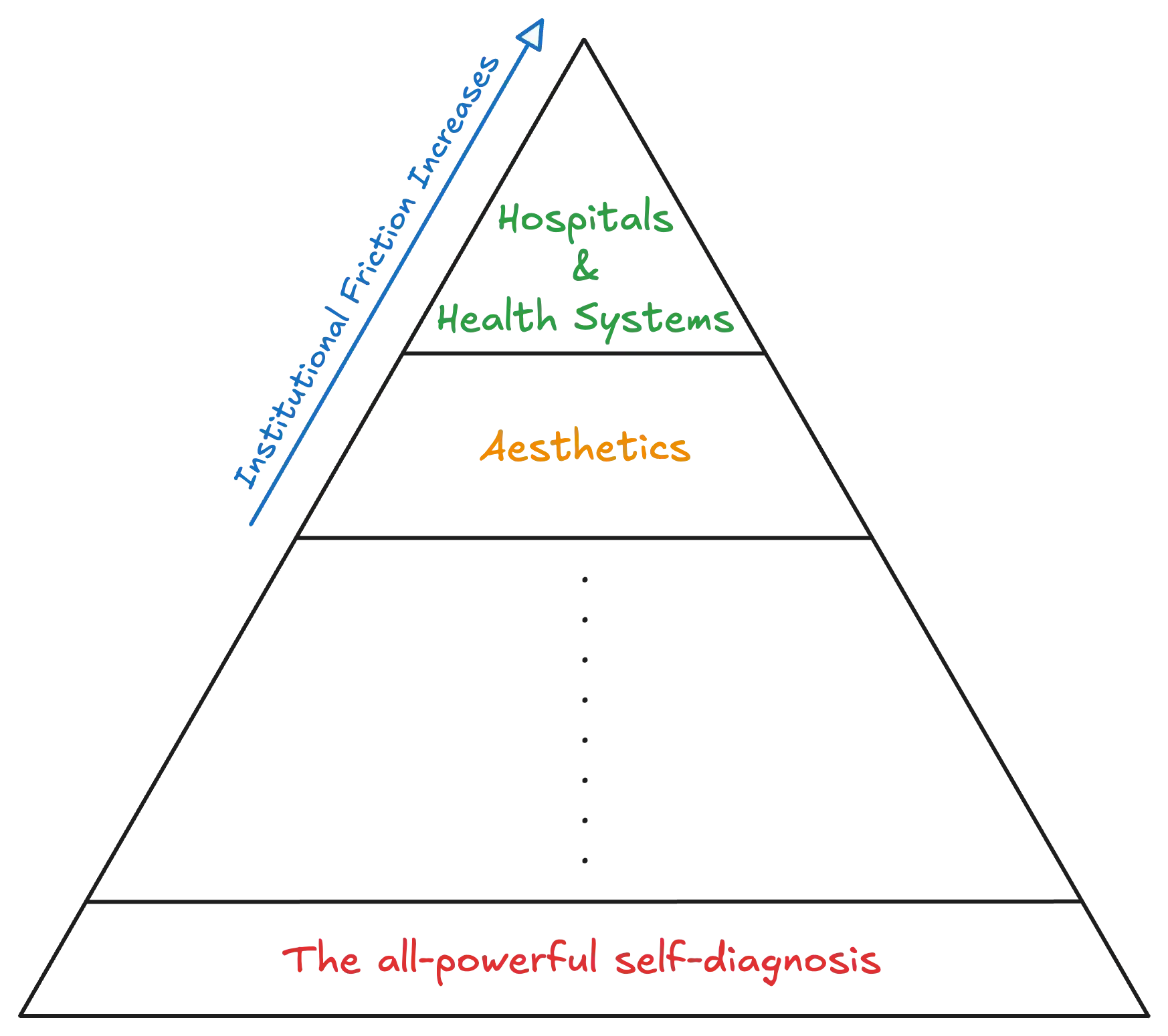
After finishing it, I came away with a loose thesis: if hospitals had little incentive to buy tools like this, perhaps smaller, commercially driven clinics would. And for whatever reason, I knew Utah had an unusually active aesthetics market. Salt Lake City has long been cited as having one of the highest concentrations of plastic surgeons per capita, and Utah shows unusually strong search interest in various procedures.
I also knew that aesthetic clinics are fundamentally different from hospitals: they tend to be owner-operated or otherwise commercially driven, operate with traditional customer-acquisition economics, and can make purchasing decisions without navigating an enormous institutional sales process.
Obviously, the original communication product was useless here. A plastic surgeon couldn't care less about a cross-hospital consultation network for procedures they perform every day. But aesthetic clinics run like traditional businesses, and like every business, there are always problems to solve.
Given Utah's strong aesthetics market, I figured there was value in helping clinics understand where demand for specific procedures was actually coming from, especially when making ad decisions or evaluating expansion locations.
I found that outside of the large chains, a lot of clinics weren't particularly sophisticated about it. Some were barely advertising at all. Others were spending money fairly broadly without much understanding of where the demand for specific procedures was concentrated geographically.
For the clinics I worked with, referrals and organic discovery were major sources of new business. That included SEO and, I would guess, recommendations surfaced by LLMs.
You can also imagine that searching for clinics has diminishing marginal returns, which you can represent in the simplest form as a logarithmic curve:
For those unfamiliar, you can think of purchasing a car. The first dealer you visit yields a massive increase in information and gives you a much better sense of price. Each subsequent dealer offers progressively smaller gains in new information or pricing insight. Your decision is then based on factors such as safety, reliability, design, and color. Outside of safety and reliability, it can just be compressed to vibes.
It's not a perfect parallel. Clinics may offer the same procedure rather than distinct products from different manufacturers, so the decision often turns on friends' referrals, how you were treated during consultations, and whether you trust the doctor. Again, vibes.
For the sake of brevity, I am going to spare implementation details but am happy to discuss them with anyone interested. Feel free to reach out.
The big picture is that I gathered as much search, ad, and geographic market data as I could and made a market-intel product that showed clinics where demand for specific procedures was concentrated. Selling it was much easier than I expected. I think part of this was that it was priced low relative to similar services. I had no idea what to charge, but the initial engagement ultimately became a way to build trust so I could work with those clients in more substantial capacities.
For example, when working with a few of these clients for a couple of months, we realized that a lot of revenue leakage wasn't necessarily solved by better-directed ads. The larger issue was inbound management. Ads were still important, but their businesses were still operating in very siloed, manual ways.
For instance, one clinic had essentially no system for following up on missed inbound calls. If somebody called and nobody answered, that potential customer could just disappear.
Automating this pipeline and building a much stronger safety net for inbound leads was the next step for these clinics. I audited systems for three clinics, unified more than 1,100 existing leads across several different sources, and built automated follow-up and lifecycle workflows around them.
Across the three clinics, this re-engaged more than 300 old prospects and increased scheduled consultations by roughly 14% over 45 days.
I don't have the data on how many of those consults translated into completed procedures, but given the economics of the business, recovering leads that otherwise would have been lost could be considerably more valuable than buying another batch of targeted ads.